
Introduction
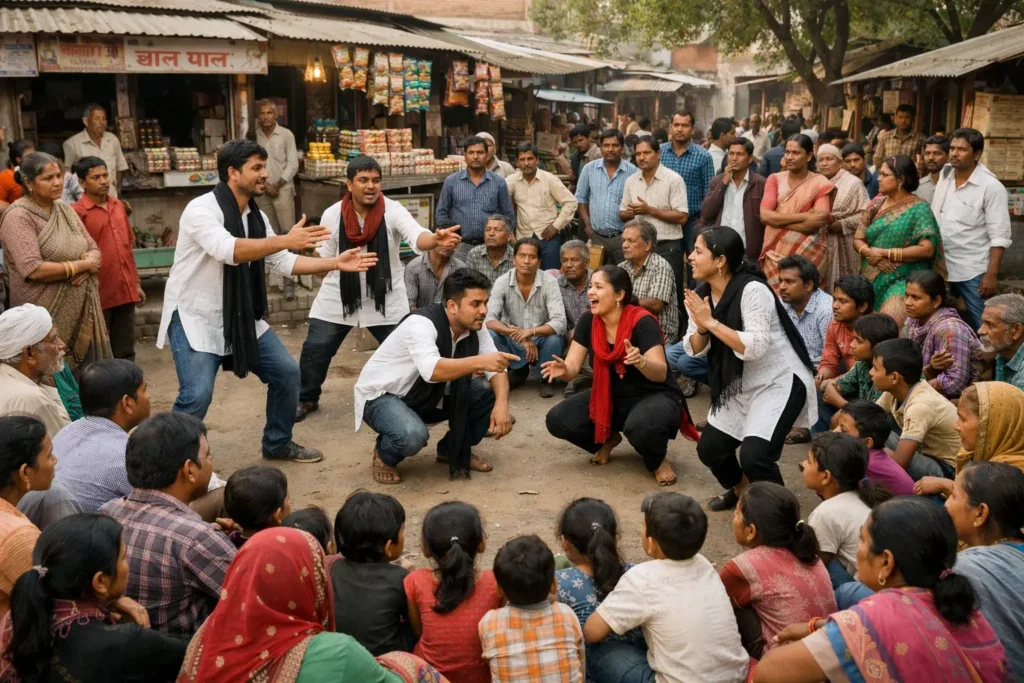
On a busy afternoon in a small town market, a group of young performers suddenly gathers in a circle. Within minutes, curious onlookers stop, forming a crowd. What begins as a simple act soon turns into a powerful story about child labour. By the end of the performance, the audience is not just watching — they are thinking, questioning, and discussing.
This is the power of street play awareness programmes, commonly known as nukkad natak in India.
Unlike formal campaigns that depend on digital media or printed materials, street plays take messages directly to people — right where they live, work, and interact. Whether performed in villages, schools, or crowded marketplaces, they create a shared space where important social issues are not just explained, but experienced.
In a country as diverse as India, where access to information and literacy levels vary, street plays offer a simple yet powerful way to communicate. They use local language, familiar situations, and emotional storytelling to make complex issues easier to understand.
Over the years, street play awareness programmes have been used by government bodies, NGOs, and educational institutions to address topics such as child labour, sanitation, gender equality, health awareness, and digital safety. Their strength lies not in technology, but in their ability to connect with people at a human level.
What are street play awareness programmes?
Street play awareness programmes are short, live performances conducted in public spaces with the aim of spreading awareness and encouraging behavioral change. They do not rely on stages, lighting, or elaborate setups. Instead, they rely on voice, expression, and storytelling.
Performers often stand in a circle, using loud voices, rhythmic clapping, and direct interaction to draw attention. Unlike traditional theatre, there is no clear boundary between the actors and the audience. People watching the play can respond, ask questions, and even become part of the performance.
For example, during a sanitation awareness campaign in a village, performers may act out a scene showing the consequences of poor hygiene. As the story unfolds, they may pause and ask the audience questions, encouraging them to reflect on their own habits.
This direct involvement makes the message more personal and memorable.
Street plays are particularly useful in areas where digital reach is limited. Even in cities, where people are constantly exposed to information, a live performance can cut through the noise and capture attention in a way that posters or advertisements often cannot.
Historical background and evolution in India
Street theatre in India is not new. It has evolved from traditional forms of storytelling and folk performances such as Tamasha, Jatra, Yakshagana, and Bhavai, where stories were used to entertain as well as educate communities.
In the modern era, street plays took on a more focused social role. During the 20th century, theatre groups began using public performances to address issues like workers’ rights, inequality, and social justice.
One of the most significant contributors to this movement was Safdar Hashmi, associated with Jana Natya Manch (JANAM). His work demonstrated how theatre could move beyond entertainment and become a tool for awareness and activism. His performances often took place in public spaces, making them accessible to everyday people rather than limited audiences.
Since the 1970s, street plays have been widely adopted in awareness campaigns across India. Today, they are used in schools, villages, urban communities, and public campaigns, continuing to evolve with changing social needs.
Why street plays work so well
Street plays are effective because they combine information with emotion. Instead of presenting facts in isolation, they tell stories that people can relate to.
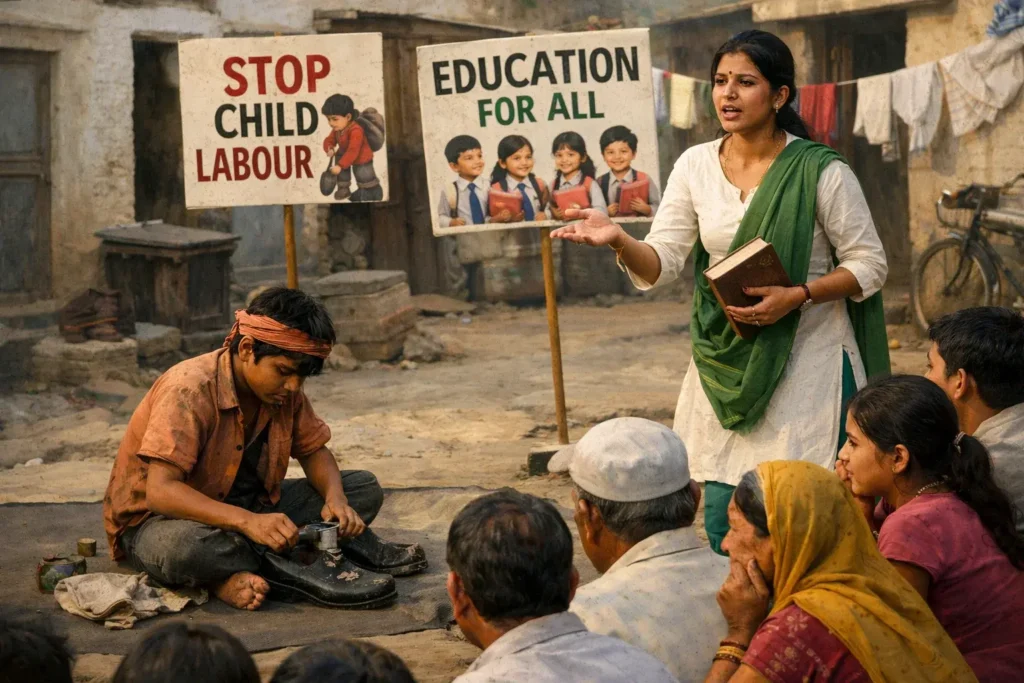
For instance, a street play about child labour might show a young child working in difficult conditions while watching other children go to school. This simple contrast often creates a stronger impact than statistics alone.
Organizations working in development communication, including UNESCO, have emphasized that people are more likely to remember messages when they are delivered through storytelling and participation rather than one-way communication.
Reference:
https://en.unesco.org/themes/communication-development
Another reason street plays work well is that they build trust. When messages are delivered in local language, by familiar faces or community members, people are more open to listening.
Role of street plays in social change
Street play awareness programmes often act as a starting point for conversations that might not happen otherwise.
For example, in some communities, topics like child marriage or domestic violence are rarely discussed openly. A street play can present these issues in a story format, making it easier for people to talk about them without feeling directly confronted.
In one case, a local NGO in Rajasthan used street plays to talk about girls’ education. After several performances in the same village, parents began enrolling their daughters in school. The change did not happen overnight, but the plays helped start a dialogue that led to gradual change.
Street plays do not solve problems instantly, but they create awareness, shift perspectives, and encourage communities to think differently.
Key issues addressed through street play awareness programmes
One of the biggest strengths of street play awareness programmes is their flexibility. A single format can be adapted to address very different issues, depending on what a community needs to hear at that moment.
In many parts of India, street plays are commonly used to talk about child rights and education. It is not unusual to see a short performance where a child is shown working in a tea stall while another child of the same age is going to school. This simple contrast often makes people pause and reflect — especially parents who may not have considered the long-term impact of keeping children out of school.
Public health is another area where street plays have made a visible difference. During cleanliness drives and sanitation campaigns, performers often use humor and everyday situations to explain hygiene practices. For example, a scene showing a family ignoring basic cleanliness, followed by illness, can communicate the importance of sanitation more effectively than written instructions.
Environmental awareness is also frequently addressed. Street plays on waste management or water conservation often connect the issue directly to daily life — such as showing how water scarcity affects farming or household routines. This makes the message practical rather than abstract.
In recent years, themes have expanded to include digital safety, cyber awareness, and gender equality. As society changes, street plays continue to evolve, taking on topics that reflect current realities.
Role of NGOs, government agencies, and educational institutions
Street play awareness programmes rarely happen in isolation. They are usually the result of collaboration between organizations that understand both the issue and the community.
Government campaigns have widely used street plays to reach people at the grassroots level. For example, during the Swachh Bharat Abhiyan, street theatre became a common sight in villages and towns. Performers would gather in public spaces and present short plays about cleanliness, open defecation, and hygiene. These performances helped translate government messages into something people could relate to in their daily lives.
Reference:
https://swachhbharatmission.gov.in/
NGOs play a more hands-on role. They often spend time within communities, understanding local challenges before designing a performance. This is why their plays feel realistic — because they are based on actual experiences.
In one instance, an NGO working in urban slums in Delhi created a street play around school dropouts. Instead of using generic messaging, they built the script around common reasons children leave school — financial pressure, lack of interest, and family expectations. Because the story felt familiar, the audience connected with it immediately.
Educational institutions also contribute significantly. College students, especially those involved in theatre groups, frequently organize street plays as part of social outreach programmes. These performances not only spread awareness but also help students understand real-world issues beyond classrooms.

Real-life impact of street play awareness programmes
The impact of street plays is often seen not in numbers immediately, but in conversations and gradual behavioral change.
In many rural campaigns, street plays have helped increase awareness about health practices such as handwashing, vaccination, and maternal care. People who might not attend formal awareness sessions are more likely to stop and watch a performance happening in a familiar public space.
Organizations like UNICEF have highlighted that communication methods involving direct interaction — such as community performances — tend to create stronger recall and understanding compared to one-way messaging.
Reference:
https://www.unicef.org/cbsc/
Street plays have also played a role in addressing sensitive issues. For example, performances on domestic violence or gender discrimination often present situations that people recognize but rarely discuss openly. By seeing these issues portrayed on the street, audiences begin to talk about them more freely.
The change may start with a conversation among a small group, but over time, it can influence attitudes across the community.
Case example: Street plays in public health campaigns
A practical example of the effectiveness of street play awareness programmes can be seen during public health initiatives.
In several states, local health departments have partnered with NGOs to organize street plays during vaccination drives. Instead of simply announcing dates and instructions, performers act out scenes showing the consequences of ignoring vaccinations, followed by positive outcomes when families participate.
In one such campaign, a short play depicted a child falling sick due to preventable disease, while another child who received timely vaccination remained healthy. The contrast was simple but powerful.
Because the message was delivered through a story rather than instructions, people were more receptive. In many cases, health workers reported better participation after such performances.
Street plays are particularly useful in areas where written communication may not be effective. They rely on visuals, dialogue, and emotion — making them accessible to a wider audience.
Advantages over conventional awareness methods
Compared to posters, pamphlets, or digital advertisements, street play awareness programmes offer a different kind of impact.
They are cost-effective and can be performed almost anywhere — from village squares to urban streets. More importantly, they create a shared experience. People watch together, react together, and often discuss the message immediately after the performance.
Another key advantage is interaction. Unlike one-way communication, street plays allow audiences to respond. Sometimes performers even pause the play to ask questions or involve the crowd, making the experience more personal.
People tend to remember stories more than instructions. When a message is delivered through characters and situations, it stays with the audience longer.
Challenges faced by street play awareness programmes
While street play awareness programmes are powerful, they are not without limitations. One of the most noticeable challenges is reach. A performance can only impact the people who are physically present at that moment. Unlike a social media post that can spread instantly, a street play depends on time, location, and audience availability.
There are also practical challenges. Performances in open spaces can be affected by weather, noise, or lack of crowd attention. Sometimes people stop for a few minutes and then leave midway, especially in busy urban areas. Keeping the audience engaged from start to finish requires skill and experience.
Funding is another concern. Although street plays are low-cost compared to large campaigns, they still require coordination, travel, rehearsal time, and committed performers. Many NGOs and student groups rely on limited resources, which can restrict how often they can organize such programmes.
In some cases, resistance from the community can also arise. When plays address sensitive topics like gender roles, child marriage, or domestic violence, not everyone may be comfortable. However, even this resistance often indicates that the issue has touched a real concern, which is sometimes the first step toward change.
Balancing traditional methods with modern communication
Street plays may be traditional in format, but they are gradually adapting to the modern communication landscape.
Today, many groups record their performances and share them on platforms like YouTube, Instagram, or WhatsApp. This allows the message to reach people far beyond the immediate audience. A play performed in one village can now be viewed by thousands online.
Educational institutions and NGOs have also started experimenting with formats inspired by street theatre. Short videos, awareness reels, and interactive sessions often follow the same storytelling approach used in street plays, but in a digital format.
Organizations working in communication and education, including UNESCO, highlight the importance of combining traditional and modern methods to reach wider and more diverse audiences.
Reference:
https://www.unesco.org/en/media-information-literacy
This blended approach ensures that the emotional strength of live performance is not lost, while also expanding its reach through digital platforms.
Importance of community participation
The real strength of street play awareness programmes lies in community involvement. When people see stories that reflect their own lives, they connect more deeply with the message.
In many successful programmes, local community members are not just the audience but also part of the performance. They help shape the script, suggest real-life situations, and sometimes even act in the play. This makes the message feel authentic rather than imposed from outside.
For example, in a village awareness programme on water conservation, local residents contributed their own experiences of water shortages. These real stories were then included in the play, making it more relatable and impactful.
Youth participation is especially important. Young performers bring energy and creativity, and they are often more comfortable addressing sensitive topics. Their involvement also encourages other young people in the community to pay attention and participate.
When communities take ownership of such programmes, the impact tends to last longer. The message is no longer seen as an external campaign but as something that belongs to them.
Sustainability of street play initiatives
One-time performances can create awareness, but long-term change requires consistency. This is where sustainability becomes important.
Street play awareness programmes are most effective when they are part of ongoing efforts rather than isolated events. Repeated performances, follow-up discussions, and integration with other initiatives help reinforce the message over time.
Partnerships play a key role here. When government bodies, NGOs, schools, and local groups work together, they can ensure continuity. For example, a sanitation campaign supported by both local authorities and community groups is more likely to sustain momentum than a single performance.
Training is another important factor. When local individuals are trained in scriptwriting and performance, they can continue organizing street plays independently. This reduces dependence on external organizations and helps build local capacity.
Funding also contributes to sustainability. Support through government programmes or corporate social responsibility (CSR) initiatives can help maintain regular activities and expand reach.
Future scope of street play awareness programmes
Even in a rapidly digital world, street play awareness programmes continue to hold strong relevance. In fact, their importance may grow as people become more overwhelmed by digital information.
Street plays offer something that technology often cannot — a direct human connection. They bring people together in a shared space, creating a moment where learning happens collectively.
Looking ahead, the future of street plays lies in adaptation. Combining live performances with digital sharing, introducing multilingual scripts, and using creative storytelling techniques can expand their impact.
New themes such as digital safety, mental health, and climate change are already being explored through street theatre. As social challenges evolve, street plays will continue to adapt, carrying forward their role as a simple yet powerful tool for awareness.
Conclusion
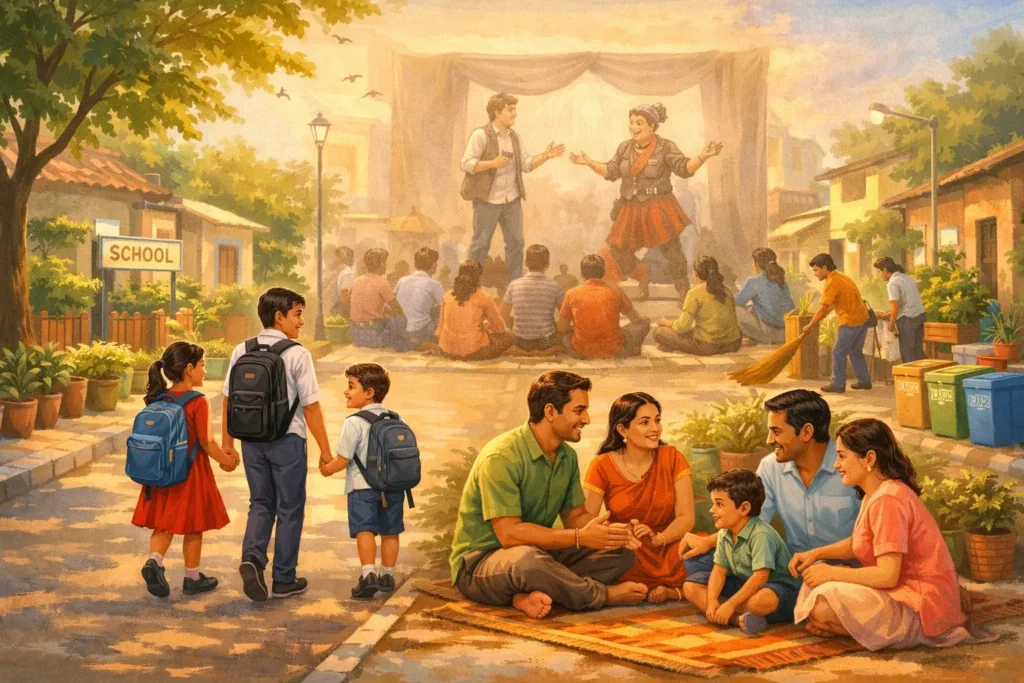
Street play awareness programmes remind us that communication does not always need technology to be powerful. Sometimes, a group of people, a simple story, and a public space are enough to start meaningful conversations.
Across India, from busy city streets to quiet village squares, street plays continue to bring important issues into the open. They do more than just inform — they make people pause, reflect, and talk. Whether it is a parent reconsidering a child’s education, a family adopting better hygiene practices, or a community beginning to question long-standing social norms, the impact often begins with a small moment created by a performance.
At the same time, the future of street plays depends on how well they adapt. By combining traditional performance with digital sharing and community participation, these programmes can reach wider audiences while maintaining their personal touch.
Ultimately, the value of street play awareness programmes lies in their simplicity and honesty. They speak directly to people, in their own language, about issues that affect their everyday lives. And in doing so, they continue to play a quiet but important role in shaping more aware and responsible communities.
References
UNESCO – Communication for Development
https://en.unesco.org/themes/communication-development
UNICEF – Communication for Development (C4D)
https://www.unicef.org/cbsc/
Swachh Bharat Mission – Government of India
https://swachhbharatmission.gov.in/
UNESCO – Media and Information Literacy
https://www.unesco.org/en/media-information-literacy
FAQs: Street Play Awareness Programmes
1. What are street play awareness programmes?
Street play awareness programmes are short live performances conducted in public spaces to spread awareness about social issues and encourage people to reflect and take action.
2. Why are street plays considered effective for awareness?
They communicate through stories and real-life situations, making messages easier to understand and remember. The direct interaction with the audience also helps create a stronger impact.
3. What types of issues are commonly addressed through street plays?
Street plays often focus on topics such as child labour, education, public health, sanitation, gender equality, environmental protection, and digital safety.
4. Who usually organizes these programmes?
They are typically organized by NGOs, government agencies, educational institutions, and local community groups working on social awareness initiatives.
5. Are street plays still relevant today?
Yes, they remain highly relevant, especially in areas where direct communication is more effective than digital messaging. They are also increasingly being combined with online platforms to reach larger audiences.
6. What role do students and youth play in street theatre?
Students and young people often lead street play initiatives. They perform, organize events, and bring fresh perspectives, making the programmes more relatable and energetic.
7. How do street plays influence people’s behavior?
By presenting familiar situations through storytelling, they help people understand the consequences of certain actions and encourage positive changes in behavior.
8. What are the main challenges faced by street play programmes?
Challenges include limited reach, dependence on physical presence, funding constraints, and sometimes resistance when addressing sensitive topics.
9. How can street play programmes become more effective?
They can improve through regular performances, stronger community involvement, better storytelling, and integration with digital platforms for wider reach.
10. Can street plays create long-term impact?
Yes, especially when they are part of continuous efforts. While a single performance may raise awareness, repeated engagement can lead to lasting social change.